
Busy Hands, Open Heart: A Devotional for the Mother Who Feels Pulled in Every Direction
Jul 21, 2026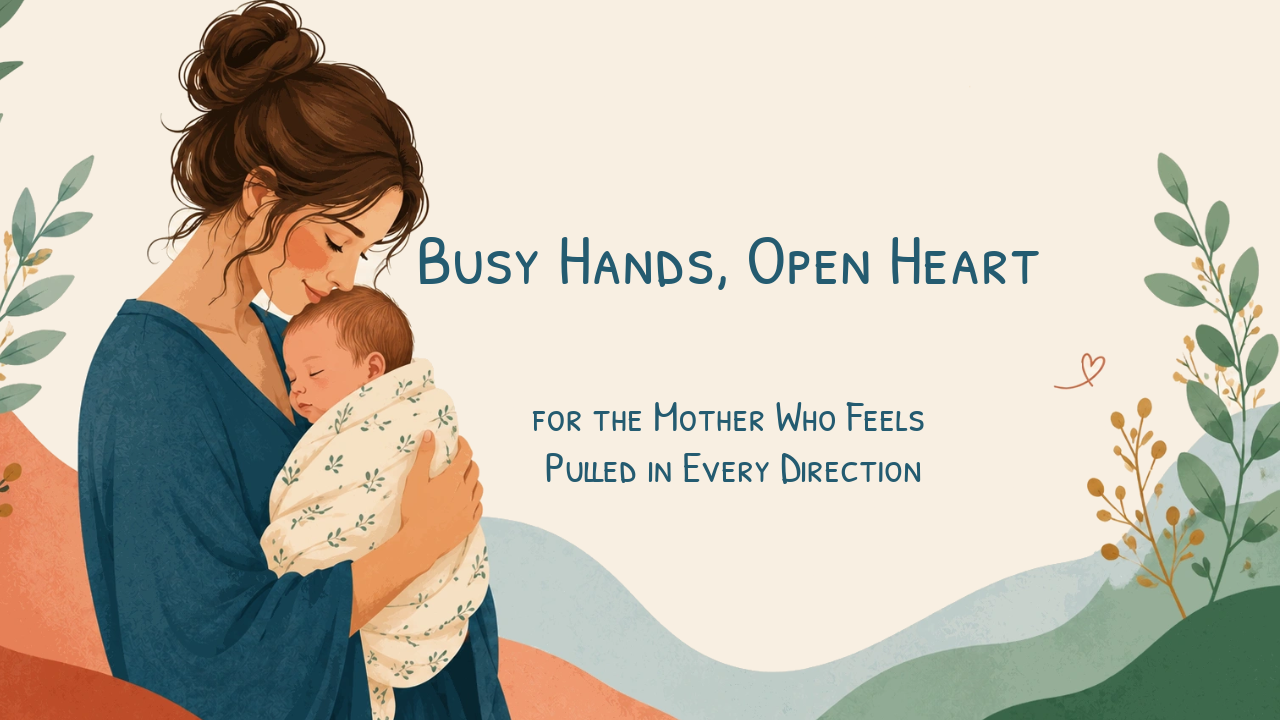
If you’re new here, I’m Alisa- a pediatric nurse practitioner and a mom of two, and I write about the things I wish someone had told me before I lived them.
Read before you begin: Luke 10:38–42 (ESV)
There’s a moment (maybe you’ve had it already, maybe it’s coming) when you’re standing in the nursery at 2 a.m., or folding the fourth load of tiny laundry, or scrolling one more article about sleep schedules, and you realize you can’t remember the last time you simply sat down. Not to accomplish something. Not to prep for the next feeding or the next appointment. To just be.
If that’s you - pregnant and buried under a to-do list, or newly postpartum and drowning in unseen tasks - I want to walk you through a story you’ve probably heard before. But I want to show it to you differently than you may have seen it.
Two Sisters, One Guest
In Luke 10, Jesus comes to the home of two sisters, Mary and Martha. Martha welcomes Him and immediately gets to work. Mary sits down at His feet and listens.
Before we go further, we need to understand what both women were actually doing, because we tend to flatten this story into “good sister, bad sister,” and that’s not what’s happening.
In that culture, hospitality wasn’t optional. It was close to a social requirement, a profound sign of respect toward your guest. Martha wasn’t fussing over nothing. She was doing exactly what a good, honorable woman was expected to do. Her serving was an act of love.
And Mary? Mary was doing something genuinely unusual. Sitting at a rabbi’s feet was the posture of a disciple... and that place wasn’t typically open to women. Mary took a seat that culture said wasn’t hers, and Jesus not only allowed it, He defended it. He called it “the good portion” that would not be taken from her.
What Jesus Actually Corrected
Here’s the part we get wrong: Jesus never rebuked Martha’s service. Read it again. What He names is her anxiety:
“you are anxious and troubled about many things” (Luke 10:41).
Martha’s hospitality wasn’t her problem. Her distraction was.
The Greek word Luke uses for “distracted” literally means to be pulled apart, dragged in different directions. And mama, if there is a single word for early motherhood, isn’t it that one? The feeding schedule and the thank-you notes and the pediatrician portal and the laundry and the mental inventory of diaper stock that runs in the background of every conversation. Pulled apart. In every direction. All at once.
Martha wanted to give Jesus the perfect meal. Jesus wanted to give Martha Himself.
Somewhere in the doing, her service replaced her communion. She was so busy hosting her guest that she stopped enjoying His presence, and her anxiety turned even her love into a burden. Busy hands aren’t the problem. It’s when busy hands crowd out an open heart.
This Story Isn’t Anti-Service
Here’s a detail I love: in Luke’s Gospel, this story comes right after the parable of the Good Samaritan. Jesus’ great picture of active, hands-on love of neighbor. Luke isn’t telling us that serving doesn’t matter. He’s showing us the order of things. Loving God through attentive discipleship is the foundation, and service flows from that place, not instead of it.
Which means Mary and Martha aren’t actually opposites. I used to read them that way: contemplative Mary, frazzled Martha, pick a team. But the invitation of this story isn’t “don’t be a Martha.” It’s this: sit first. Serve from fullness, not from frenzy.
What This Means When You’re Expecting, or Holding a Newborn
Pregnancy and new motherhood are Martha seasons by design. There is real work: the nursery, the registry, the feeding, the appointments, the recovery, the night shifts. None of it is optional, and all of it is love. You cannot excuse your way out of a 3 a.m. feeding.
But hear this: your baby doesn’t need a perfect meal. Your baby needs you, and you need Him.
The Psalmist gives us a picture that should stop every mother in her tracks: a soul that has been “calmed and quieted… like a weaned child with its mother” (Psalm 131:2). Think about that. The image God chooses for rest in His presence is a content baby against its mother’s chest. You will spend this season becoming that picture for your child. And God is inviting you to receive it for yourself - to be the child, held and quieted, not just the one doing the holding.
And you can come to Him that way because of who you are to Him. Romans says you didn’t receive a spirit of slavery to fall back into fear. You received the Spirit of adoption. You are a daughter, an heir. You cry out to a Father, not a taskmaster. (Romans 8:15–17, ESV.)
A slave serves to earn her place. A daughter serves because she already has one.
When You Feel Weak (Because You Will)
Maybe the hardest part of this season is how insufficient it makes you feel. Your body is tired in ways you didn’t know a body could be tired. You will not do it all well. Some days you will not do it all, period.
Paul knew something about unrelenting weakness. He begged God to remove his thorn, and God answered: “My grace is sufficient for you, for my power is made perfect in weakness” (2 Corinthians 12:9). Paul’s conclusion wasn’t to try harder. It was to stop hiding his weakness, because that’s exactly where Christ’s power rests.
Your exhaustion is not disqualifying you from this season. It may be the very place God meets you in it.
The Freedom on the Other Side
So what does Mary’s posture look like for a woman with a newborn on her chest and a list in her head?
It looks like thirst before tasks, “as a deer pants for flowing streams” (Psalm 42:1), letting your soul want God before your hands reach for the next thing. Some days that’s a full quiet time. Most days it’s a whispered prayer during a feeding, maybe worship playing while you wash the dishes. Sitting at His feet in this season might literally happen sitting in a glider at 4 a.m. That counts. That’s the good portion.
It looks like praying from adoption, not performance. Galatians 4:6–7 tells us the Spirit in you cries “Abba! Father!” - you’re no longer a slave, but a daughter and an heir. You don’t earn your place at His feet by finishing the list. You already have it.
And it looks like refusing to be re-enslaved by the impossible standard. You've seen it - the Pinterest nursery, the perfectly tracked feeding log, the version of motherhood that demands you be pulled apart to prove your love. “For freedom Christ has set us free; stand firm therefore, and do not submit again to a yoke of slavery” (Galatians 5:1). Anxiety is a yoke. Perfectionism is a yoke. Christ already broke them. Don’t pick them back up in the name of being a good mom.
Busy Hands, Open Heart
You will serve this season - beautifully, sacrificially, at hours you didn’t know existed. That service is holy. But it was never meant to be the source of your worth or the substitute for His presence.
Martha wanted to give Jesus the perfect meal. Jesus wanted to give her Himself.
He wants to give you Himself, too. Not after the laundry. Not once you’ve figured out the feeding schedule. Now. In the mess, in the middle, in the being pulled apart. One thing is necessary, and it will not be taken from you.
Sit first. Serve from there.
Reflect
- Where in this season do you feel most “pulled apart”? Name the specific tasks or worries out loud or on paper. Jesus named Martha’s anxiety before He addressed it.
- Martha’s service replaced her communion. Is there a place in your preparation for baby (or care of baby) where doing has quietly replaced being with God?
- Read Psalm 131:2 slowly. What would it look like this week to let yourself be the quieted child in God’s arms, even for five minutes?
- Are you serving like a daughter or striving like a slave (Galatians 4:6–7)? What’s one standard or expectation you need to set down as a “yoke” this week?
- What is one realistic way you can “sit at His feet” in this exact season of life?
This entry is part of an ongoing devotional series for moms. Each entry is designed to be read slowly, prayed through, and returned to. Read more here:
Who Told You That? Replacing the lies we carry with the truth of who God says we are
Author