3 Things I Knew as a Pediatric NP That Hit Different as a New Mom
Oct 15, 2026
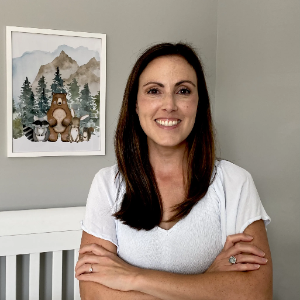
If you’re new here, I’m Alisa- a pediatric nurse practitioner and a mom of two, and I write about the things I wish someone had told me before I lived them.
I spent years caring for babies and talking with their parents before I ever brought my own daughter home. I knew the stats. I knew the screening tools. I could explain postpartum recovery to a nervous first-time mom without missing a beat.
And then I became one.
Knowing something as a clinician and living it as a new mom are two very different things. Here are three things I understood professionally that hit completely different once they were mine.
1. Your identity really does change (and that's normal)
I knew, clinically, that becoming a mother changes you. I didn't expect it to feel like the ground shifting under my feet.
For me, it hit when it was time to go back to work. I had worked hard to climb the ladder. I'd put years into building a career I was proud of. And suddenly, the things I'd chased so hard didn't matter nearly as much. My daughter mattered more. Much more.
I found myself asking questions I hadn't asked in years:
- Who am I now?
- Who am I as a mom?
- What do I actually value?
- What are my priorities, and do they still match how I spend my time?
- How have my friendships and relationships changed?
If you're asking those questions too, you're not lost. You're in the middle of matrescence.
What is matrescence?
Matrescence is the developmental transition into motherhood. Anthropologist Dana Raphael coined the term in the 1970s, and it's often compared to adolescence. Like adolescence, it involves big physical, hormonal, emotional, and social changes all at once. And like adolescence, it takes time. (I go deeper on this in my post on matrescence.)
What surprises a lot of moms is that this shift isn't only emotional. It's biological.
Your brain is changing too
Researchers, including Dr. Elseline Hoekzema and Dr. Susana Carmona, found that pregnancy causes measurable changes in brain structure. These include reductions in gray matter in regions involved in social cognition, the areas that help us understand what other people need and feel. Some of those changes lasted at least two years after birth (Hoekzema et al., 2017).
The researchers don't read this as decline. They read it as specialization. Your brain may be fine-tuning itself to read and respond to your baby.
So the version of you that feels unfamiliar right now isn't a broken version of the old you. She's someone new, and she's still forming.
What helps:
- Give yourself permission to not have the answers yet.
- Name what's changed out loud with someone safe, like your partner, a friend, or a therapist.
- Revisit your priorities on purpose instead of by default. It's okay if they look different now.
- Notice what still lights you up. Some parts of you are still very much there.
2. Your partnership changes too
I knew relationships change after a baby. I've talked with plenty of parents in exam rooms who were clearly running on fumes and short on patience with each other.
My husband and I went in as pretty decent communicators. But a newborn has a way of shining a light on the patterns you didn't know you had.
Some of our communication habits worked fine when we were well rested and had time to talk. They did not work at 2 a.m. with a crying baby. We had to get better at saying what we needed clearly, instead of hoping the other person would notice.
The biggest thing for me was learning to ask for help. As a nurse practitioner, I was used to being the helper. Asking felt like admitting I couldn't handle it. But nobody can do newborn life alone, and my husband couldn't support me in ways I never told him about.
We had to work through questions like:
- Who are we as partners now?
- How do we communicate well when we're both exhausted?
- How do we split the load in a way that works for us right now?
- How do we make sure both of our needs still matter?
What helps:
- Talk before baby arrives about how you'll handle nights, feeding, chores, and visitors.
- Make direct requests. "Can you take the 3 a.m. feed so I can sleep four hours?" works better than "I'm so tired."
- Schedule short check-ins, even ten minutes, to ask each other how you're really doing.
- Assume you're on the same team, especially when you're both running on empty.
I made a guide, Before Baby Comes Home, to help couples have these conversations before the newborn fog sets in.
3. The postpartum care gap is real
This is the one that hit hardest.
As a clinician, I knew there were gaps in postpartum care. I knew moms often fall through the cracks after delivery. I'd seen it from the outside.
Then I went through postpartum anxiety and depression myself.
My symptoms showed up after my six-week checkup. My OB had already, in a sense, signed off. I'd been seen constantly during pregnancy, and then suddenly I wasn't. I was struggling and genuinely confused about who was supposed to be managing my care. My OB? My primary care provider? A mental health provider I didn't have yet?
If someone with my training felt lost, I can only imagine how confusing it is for parents without a medical background.
What ACOG actually recommends
The American College of Obstetricians and Gynecologists (ACOG) says postpartum care should be an ongoing process, not a single visit. Its recommendations are:
- contact with your OB or another maternal care provider within the first three weeks after birth
- ongoing care as needed
- a comprehensive postpartum visit no later than 12 weeks
That visit should cover your mood and emotional well-being, not just physical healing (ACOG, 2018).
ACOG also recommends that you and your provider identify who will take over your ongoing care after the postpartum period. In real life, that handoff often doesn't happen. So ask about it directly, ideally before you deliver.
Baby blues vs. postpartum depression
One of the hardest parts was trying to figure out what was normal.
- Baby blues are very common, affecting an estimated 50 to 80 percent of new moms. They look like tearfulness, mood swings, and feeling overwhelmed in the first couple of weeks, and they usually ease within about two weeks.
- Postpartum depression lasts longer than two weeks, feels heavier, and makes daily life harder. It can start anytime in the first year, not just the first few weeks. About 1 in 8 new moms in the U.S. report postpartum depression symptoms (Bauman et al., 2020).
Depression isn't the only perinatal mood and anxiety disorder (PMAD). Others include postpartum anxiety, postpartum OCD, postpartum PTSD, and, more rarely, postpartum psychosis, which is a medical emergency. Racing thoughts, constant worry, or not being able to rest even when the baby sleeps all count. You don't have to feel sad for something to be wrong.
Treatment while breastfeeding
Here's something I didn't fully expect. Many providers are hesitant to prescribe for or treat postpartum moms who are breastfeeding, especially if they aren't familiar with medication use during lactation.
That hesitation can leave moms untreated, or push them to choose between their mental health and feeding their baby. In many cases, that's an unnecessary choice. There are treatment options, including several medications, that are commonly used while breastfeeding. The right choice is an individual decision made with a provider who knows this area well.
If a provider isn't comfortable, it's okay to ask for a referral to someone who is, such as a perinatal psychiatrist or a provider trained in perinatal mental health.
What helps:
- Before you deliver, ask your OB: "Who manages my care after my postpartum visit?"
- Know the signs of PMADs, and share them with your partner so they can watch for them too.
- If something feels off, speak up.
- If you're breastfeeding and need treatment, ask specifically for a provider experienced in perinatal mental health.
- If you're struggling, you can call or text the National Maternal Mental Health Hotline at 1-833-TLC-MAMA (1-833-852-6262). It's free, confidential, and available 24/7. If you're having thoughts of harming yourself or your baby, call 988 or 911, or go to your nearest emergency room.
What I want you to know
I had the training. I had the knowledge. And it still caught me off guard.
That's not a failure. It's a sign of how big this transition really is. You are becoming someone new, your relationship is becoming something new, and the care system around you isn't always built to catch you.
The best thing you can do is prepare before baby arrives. Talk about these things now. Make a plan for your care. Know what's normal and what's not.
That's exactly why I created the New Parent Prep Class. It covers the things I wish every parent knew before bringing their baby home, from newborn care to your own recovery and mental health.
You deserve to be prepared, not just for your baby, but for you.
References
American College of Obstetricians and Gynecologists. (2018). ACOG Committee Opinion No. 736: Optimizing postpartum care. Obstetrics & Gynecology, 131(5), e140–e150. https://doi.org/10.1097/AOG.0000000000002633
Bauman, B. L., Ko, J. Y., Cox, S., D'Angelo, D. V., Warner, L., Folger, S., Tevendale, H. D., Coy, K. C., Harrison, L., & Barfield, W. D. (2020). Vital signs: Postpartum depressive symptoms and provider discussions about perinatal depression — United States, 2018. MMWR Morbidity and Mortality Weekly Report, 69(19), 575–581. https://doi.org/10.15585/mmwr.mm6919a2
Health Resources and Services Administration. (n.d.). National Maternal Mental Health Hotline. https://mchb.hrsa.gov/national-maternal-mental-health-hotline
Hoekzema, E., Barba-Müller, E., Pozzobon, C., Picado, M., Lucco, F., García-García, D., Soliva, J. C., Tobeña, A., Desco, M., Crone, E. A., Ballesteros, A., Carmona, S., & Vilarroya, O. (2017). Pregnancy leads to long-lasting changes in human brain structure. Nature Neuroscience, 20(2), 287–296. https://doi.org/10.1038/nn.4458
Author