Why New Parenthood Doesn't Have to Be Either/Or
Aug 07, 2026
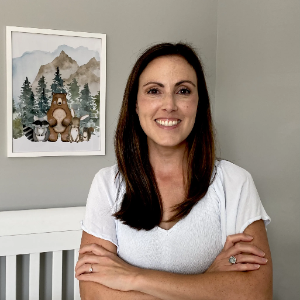
If you’re new here, I’m Alisa- a pediatric nurse practitioner and a mom of two, and I write about the things I wish someone had told me before I lived them.
Somewhere along the way, new parenthood got sold to us in black and white. Breastfeed or formula feed. Sleep train or don't. Ask for help or prove you can do it alone. As if every decision you make in those first weeks and months is a referendum on what kind of parent you are.
But real life - especially the tender, disorienting season of bringing a baby home - rarely fits into two neat boxes. It's not either/or. It's both/and.
Both/and thinking means holding two seemingly opposite truths at the same time, without needing to resolve them into one "right" answer.
Things like...
You can be deeply grateful and utterly exhausted.
You can trust your body and need medical help.
You can love your baby fiercely and mourn the life you had before.
This isn't just a feel-good reframe… it's actually a more accurate way to describe what's happening to you. You're in the middle of matrescence (and for partners, patrescence): the developmental transition into parenthood, not unlike adolescence, where your identity, hormones, relationships, and sense of self are all shifting at once. Of course it feels like two things are true simultaneously. Two things are true simultaneously.
So if you've been waiting for the moment things start feeling simple - here's permission to stop waiting, and start allowing things to feel layered instead.
Here are 10 both/and truths about new parenthood:
1. Breastfeeding can be deeply beneficial and still not be the right or sustainable choice for you.
Breastfeeding and human milk are considered the normative standard for infant feeding, offering short- and long-term benefits for both baby and mother (Meek & Noble, 2022). It can also be physically painful, emotionally draining, logistically impossible, or simply not what a family wants to do, and all of that can be true while still making a fully loving feeding choice.
2. You can prepare intensely for an unmedicated birth - and still need medical intervention.
Preparation and flexibility aren't opposites. A birth that requires intervention isn't a failure - it's often exactly why the plan included a team who could adapt with you.
3. You can be an attentive, safe-sleep-informed parent - and still end up bedsharing at 3am out of sheer exhaustion.
The American Academy of Pediatrics recommends room-sharing without bed-sharing, a firm, uncluttered sleep surface, and back-sleeping for every sleep to reduce the risk of sleep-related infant death (Moon et al., 2022). Following this guidance closely matters, and real life doesn't always match the guideline. If bedsharing happens, the safest approach is talking openly and without judgment with your pediatrician about reducing risk, not hiding it out of shame. (Also, in the meantime, check out the Safe Sleep Seven from La Leche League to learn more about safer bedsharing)
4. You can love having visitors - and need them to leave sooner than you told them they could stay.
Wanting company and needing solitude aren't contradictory. Boundaries can shift in real time, and that's not rude… it's self-aware.
5. You can be a capable, competent parent - and still need someone to hold the baby so you can shower.
Needing help isn't evidence you can't do this. It's evidence you're doing something that was never meant to be done alone.
6. You can feel instantly bonded to your baby - or feel that bond grow slowly over weeks - and both are normal.
Mild to moderate bonding difficulties are common in the postpartum period (Kerstis et al., 2023). A slow-building bond is well within typical range. That said, if bonding difficulty is persistent or paired with symptoms like hopelessness or intrusive thoughts, it's worth screening for a perinatal mood or anxiety disorder with your provider (American College of Obstetricians and Gynecologists [ACOG], 2023).
7. You can be deeply grateful for your baby - and grieve the life, body, or freedom you had before.
Gratitude doesn't cancel out grief. Missing your old life doesn't mean you regret your new one.
8. You can love your partner - and feel real resentment toward them in the newborn haze.
Resentment in this season is often less about the relationship and more about the invisible load, and naming it honestly is healthier than pretending it isn't there.
9. You can be proud of what your body did - and still struggle to recognize it in the mirror.
Awe and grief about your postpartum body can coexist. Neither one cancels the other out.
10. You can be managing well - and still need to tell someone that you're not okay.
Functioning and struggling aren't mutually exclusive. ACOG recommends that all women be screened for depression and anxiety at least once during the perinatal period, since symptoms can be present even when someone appears to be coping (ACOG, 2023). You can be showing up for your baby every day and still be carrying something that deserves support - that's not a contradiction, it's a reason to reach out.
The Takeaway
Postpartum isn't asking you to pick a side. It's asking you to hold complexity, to let things be hard and good, scary and survivable, uncertain and still okay. That's not a contradiction. That's just what this season looks like in color instead of black and white.
If you want more support navigating this season, my New Parent Prep Class walks you through exactly what to expect.
For more from me on postpartum and newborn care:
- You're Not Losing Yourself. You're Becoming Someone New: A Mom's Guide to Matrescence
- The Co-Sleeping Conversation We're Not Having - But Should Be
-
Breastfeeding, Formula, and the Space Between: A Pediatric NP's Take
References
American College of Obstetricians and Gynecologists. (2023). Screening and diagnosis of mental health conditions during pregnancy and postpartum: ACOG clinical practice guideline no. 4. Obstetrics & Gynecology, 141(6), 1232–1261. https://doi.org/10.1097/AOG.0000000000005200
Kerstis, B., Bhatia, R., & Elgán, C. (2023). Associations between maternal psychological distress and mother-infant bonding: A systematic review and meta-analysis. Archives of Women's Mental Health. https://doi.org/10.1007/s00737-023-01332-1
Meek, J. Y., & Noble, L. (2022). Policy statement: Breastfeeding and the use of human milk. Pediatrics, 150(1), e2022057988. https://doi.org/10.1542/peds.2022-057988
Moon, R. Y., Carlin, R. F., & Hand, I. (2022). Sleep-related infant deaths: Updated 2022 recommendations for reducing infant deaths in the sleep environment. Pediatrics, 150(1), e2022057990. https://doi.org/10.1542/peds.2022-057990
Author